Ask five web designers what a small business website costs and you’ll get five different answers, from a few hundred pounds to several thousand, before anyone mentions monthly fees. The prices aren’t random. They depend on what’s being built, who builds it, and what happens after it goes live.
Here’s what you’re paying for, the usual ways to get a website in the UK, and how to tell whether a quote is fair. We’ll be open about our own prices too, so you have one fixed point to compare against.
What you’re actually paying for
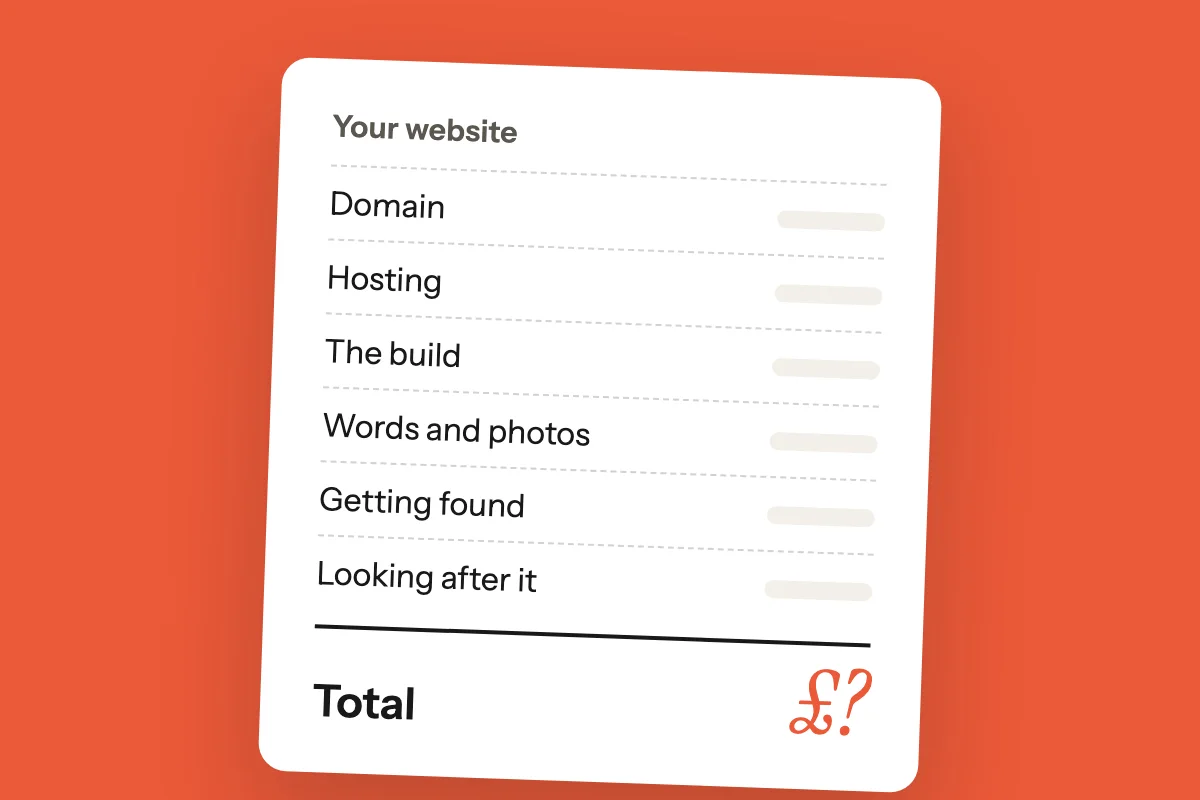
Every website has the same handful of costs. Some quotes bundle them together; others leave some out and add them later.
- The domain name. Your address, like yourbusiness.co.uk. A small yearly fee to a registrar, and it should be registered in your name.
- Hosting. The server the site lives on. Cheap hosting is easy to find; fast, secure hosting that someone keeps an eye on costs more.
- The build. Planning, designing and building the pages. This is the biggest one-off cost, and the one that varies most.
- The words and photos. Someone has to write the copy and supply the images. If that’s you, it costs time; if it’s the designer, it costs money.
- Getting found. Page titles and descriptions, links between your pages, and your Google Business Profile, Search Console and Analytics set up. Often missing from cheap quotes.
- Looking after it. Software updates, security, fixes, and changes when your prices, photos or opening hours change. The cost most people forget, and it lasts as long as the site does.
The four usual ways to get a website
1. Build it yourself with a website builder
You pay a monthly plan to a builder like Wix or Squarespace and build the site yourself from a template.
What it costs: a monthly subscription, plus your time. Good for: people who enjoy tinkering and have a simple business. Watch for: your time is the real cost, and the site is only as good as the hours you put in. You’re the web team from then on.
2. A freelancer
One person designs and builds the site for a one-off fee.
What it costs: a one-off fee, usually the lowest of the pay-someone options. Good for: a straightforward site with a clear brief. Watch for: what happens after launch. Ask who hosts it, who updates it and what changes cost. If the freelancer moves on, you need someone who can pick it up.
3. An agency
A team plans, designs and builds the site, often with a strategy phase and design rounds first.
What it costs: the highest one-off fee, often with a monthly retainer for hosting and support on top. Good for: larger sites, complex features, or businesses that want a lot of say at the design stage. Watch for: paying for process you don’t need, and support that goes through an account manager rather than the people who built the site.
4. A monthly or yearly plan
The site is built, hosted and looked after for a regular fee instead of a big bill up front.
What it costs: a monthly or yearly fee. Good for: small businesses that want a proper site without a large outlay, and someone else to look after it. Watch for: who owns the website, whether there’s a minimum term, and what happens if you stop paying. Our page on pay monthly websites explains how ours work.
What we charge
We sell websites on plans, so our prices are fixed and published:
- Subscription, from £20 a month. We build, host and look after the site. Nothing up front and no minimum term. The site is ours and you subscribe to use it.
- Yearly, £250 a year. The same build and care, paid yearly, and the website is yours to keep.
- Bespoke, quoted. A hand-made design in Figma or Adobe XD with unlimited changes before we build, and features like shops, bookings or payments.
Every plan includes hosting, support and changes by email, on-site SEO, internal linking, and your Google Business Profile, Search Console and Analytics set up for you. The full comparison is on our pricing page.
Questions that tell you whether a price is fair
Whoever you talk to, ask these before you pay anything:
- Who owns the website, and the domain? You should always own your domain. Ownership of the site itself depends on the deal, so get it in writing.
- What’s included after launch? Hosting, updates, fixes and changes: which are in the price, and which are extra?
- What does a change cost? New prices, a new photo, a new page. Ask for the rate.
- Is it built for my business, or from a template? Neither is wrong, but you should know which you’re paying for.
- What happens if I leave? Do you get your files and content? Is there a minimum term or a notice period?
- Is Google set up? Titles and descriptions, your Business Profile, Search Console and Analytics. A site nobody can find costs the same as one that brings in work.
- Who will I deal with? The person who builds the site, or someone passing messages along?
The short answer
A small business website can cost a few hundred pounds or several thousand. What the price covers matters more than the number: a cheap build with nothing after launch can end up costing more than a fair yearly fee that includes everything.
If you’d like a second opinion on your current site before you spend anything, run a free website review. It scores your current site in about a minute and lists the fixes that matter most, so you can see whether it needs replacing.