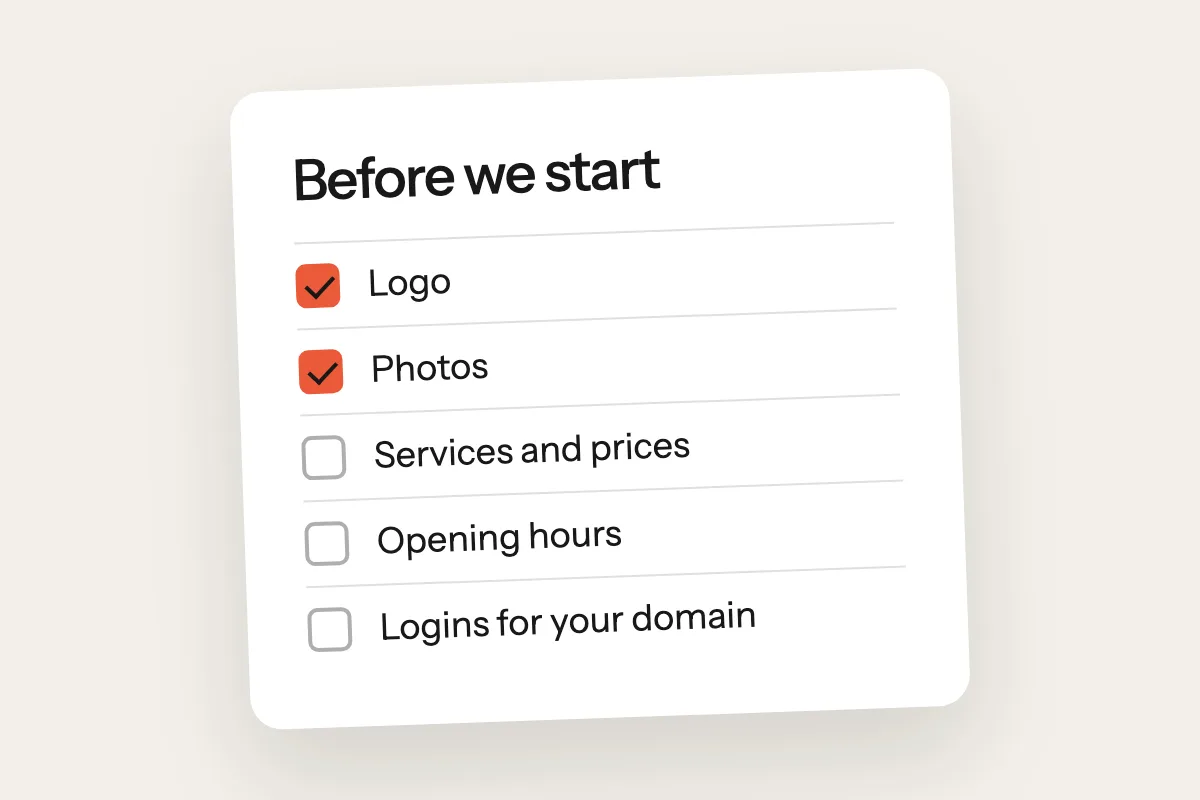
The slowest part of most website projects isn’t building the site. It’s waiting for the things only the business can provide. Gather these before you start and everything moves faster.
Your logo
The best version you have, ideally the original file from whoever designed it. Vector files (SVG, EPS, AI or PDF) are best; a large PNG with a transparent background is next. A logo copied from a social media profile is usually too small.
Photos
Real photos of your work, your premises and your team do more for a small business than stock images ever will.
- Take them in good, natural light.
- Get a mix of wide shots and close-ups.
- Shoot some upright and some landscape; websites use both.
- If you can, send the original files rather than ones that have been through a messaging app, which shrinks them.
A phone camera is fine. A few good photos beat a lot of average ones.
Services and prices
List what you do, in the words your customers use. Add prices if you’re happy to show them, even as “from” prices. People are far more likely to get in touch when they have a rough idea of cost.
Opening hours and contact details
Your hours, the email address and number customers should use, your address or the areas you cover, and your social media links.
Who your customers are
A sentence or two on who you serve and where. “Families in Darlington” or “trade customers across the North East” shapes everything from the wording to the pages the site needs.
What you want visitors to do
Book an appointment, send an enquiry, buy something, or ring you? Decide the main one. A website that asks for everything usually gets nothing.
Your current website and logins
If you have a website already, send the address, and find your logins for:
- your domain name, wherever it was registered
- your hosting, if it’s separate
- email, if it’s tied to the domain
Lost logins are the most common hold-up when moving a site. Your old provider can usually help you recover them.
Your Google accounts
If you already have a Google Business Profile, Search Console or Analytics, be ready to give access rather than starting again. If you don’t, that’s fine; we set them up. Here’s what a proper Google Business Profile looks like.
Reviews
Any reviews you’re proud of, from Google, Facebook or elsewhere. Check the reviewers are happy to be quoted.
Sites you like
Two or three websites you like, and what you like about them. They don’t have to be in your trade.
What can wait
You don’t need perfect wording, every photo or a finished price list to get started. Send what you have; the gaps get filled as we go.
Once you’ve got the basics together, tell us about your business. If you’d like to know what happens next, here’s how it works.